
The Netherlands 30% Ruling: The Complete Expat Guide (2026)
If you're considering a move to the Netherlands for work, you've likely heard about the 30% ruling (30%-regeling). It's one of the most generous expat tax benefits in Europe, and it can make a significant difference to your take-home pay. But the ruling has been changing, and understanding what you qualify for in 2026 and beyond is critical.
This guide covers everything you need to know: what the 30% ruling is, whether you're eligible, how much you'll save, how to apply, what's changing in 2027, and how the Netherlands stacks up against other expat-friendly countries. All information is verified against official Dutch government sources.
What is the 30% ruling?
The 30% ruling (officially called the extraterritoriale kostenregeling or "expat scheme") is a Dutch tax benefit for highly skilled workers recruited from abroad. In simple terms, it allows your employer to pay 30% of your gross salary tax-free as a compensation for the extra costs of living and working outside your home country (so-called "extraterritorial costs").
These extraterritorial costs include things like:
- Higher cost of living in the Netherlands compared to your home country
- Double housing costs during the transition period
- Travel expenses to visit family in your home country
- Language courses and cultural integration costs
- Cost of obtaining official documents (visas, permits, diploma validations)
Instead of itemizing and proving each of these costs, the ruling provides a flat 30% exemption — making it simple for both employer and employee.
Example:
On a gross salary of €80,000, 30% (€24,000) is paid tax-free. You only pay income tax on the remaining €56,000 — the "taxable wage." This can save you over €10,000 per year in taxes compared to someone without the ruling.
The ruling applies for a maximum of 5 years (60 months). It was 10 years before 2012, then 8 years, and was reduced to 5 years from January 2019.
Eligibility criteria: do you qualify?
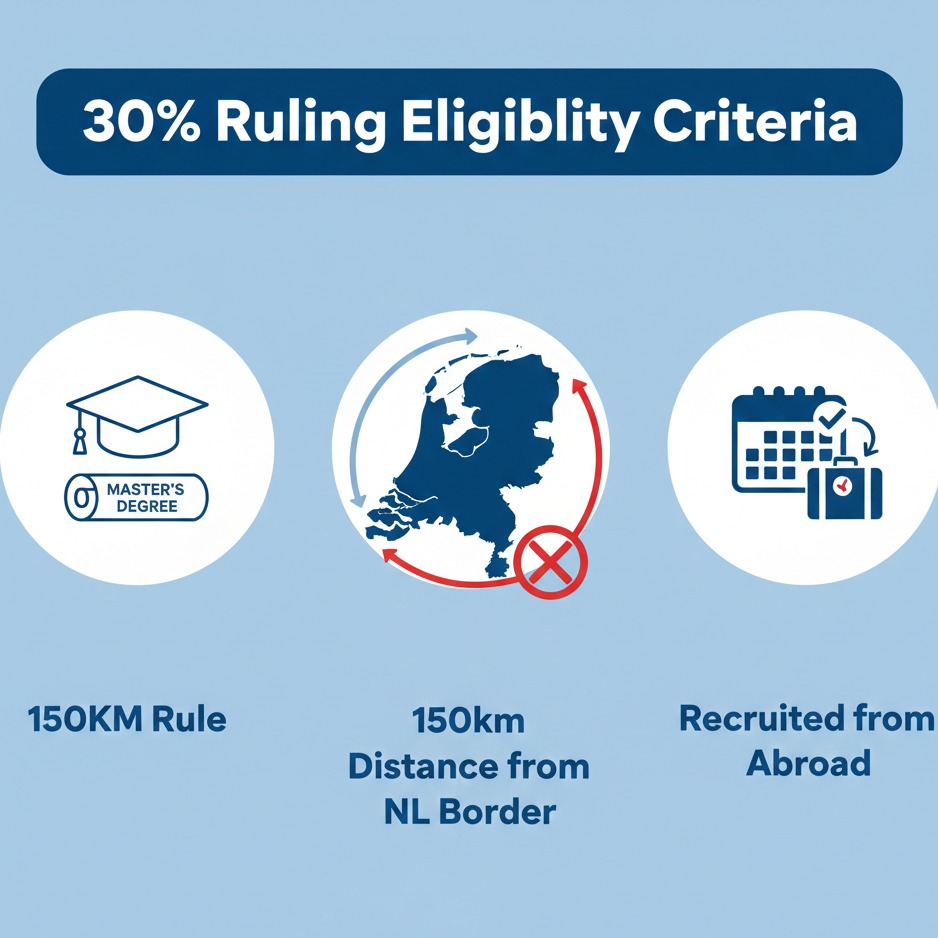
To qualify for the 30% ruling, you must meet all of the following conditions, as specified by the Belastingdienst (Dutch Tax Administration):
1. Recruited from abroad
You must be recruited or transferred from outside the Netherlands to work for a Dutch employer. This means you were living and working abroad when your Dutch employer hired you. If you were already living in the Netherlands when you found your job, you generally won't qualify.
2. The 150-kilometer rule
For at least 16 of the 24 months before your first day of work in the Netherlands, you must have lived more than 150 kilometers from the Dutch border. This is measured as a straight-line distance. This means people from Belgium, Luxembourg, parts of Germany, and northern France generally don't qualify — they live too close.
Who typically qualifies?
Expats from the UK, India, the US, Turkey, Italy, Spain, Eastern Europe, and most countries outside the immediate Dutch border region. If you're from Dusseldorf or Antwerp, you're likely too close.
3. Specific expertise (salary threshold)
You must bring "specific expertise" that is scarce in the Dutch labor market. In practice, this is proven by earning above a minimum salary threshold, which is adjusted annually. For 2026:
- €48,013 gross per year (general threshold, excluding the 30% tax-free allowance)
- €36,497 gross per year for employees under 30 with a qualifying Master's degree
- No minimum for scientific researchers at designated institutions and doctors in specialist training
4. Employment with a Dutch withholding agent
You must be employed by an employer that is required to withhold Dutch payroll tax. This includes Dutch companies and foreign companies with a Dutch payroll.
5. No prior Dutch residency (general rule)
If you've previously lived or worked in the Netherlands, your eligibility may be reduced or denied. Time spent in the Netherlands within the 25 years before your current employment can reduce your 5-year maximum. The Belastingdienst will specify the exact end date in your approval letter.
Salary thresholds: 2024–2026
The salary thresholds are adjusted each year. Here's how they've evolved:
Salary thresholds by year
| Year | Regular threshold | Under 30 + Master's | Max salary cap (WNT) |
|---|---|---|---|
| 2024 | €41,954 | €31,891 | €233,000 |
| 2025 | €46,660 | €35,468 | €246,000 |
| 2026 | €48,013 | €36,497 | €262,000 |
Important: the WNT cap (Balkenende norm)
Since 2024, the 30% tax-free benefit only applies up to a maximum salary of €262,000 (2026). If you earn more, the portion above this cap is taxed normally. The maximum untaxed allowance for 2026 is therefore €78,600 (30% × €262,000) for a full year.
How it works in practice: the numbers
The impact on your take-home pay is substantial. The chart below shows the approximate difference in annual net income for various salary levels — with and without the 30% ruling.
Approximate net income: with vs without 30% ruling (2026)
Based on Dutch Box 1 tax brackets. Excludes social contributions and tax credits for simplicity.
And here's the annual tax savings broken down:
Annual tax savings from the 30% ruling
Difference in approximate take-home pay (with vs without 30% ruling)
How the calculation works
The Netherlands uses progressive tax brackets for Box 1 income (employment income) in 2026:
- • Up to €38,883: taxed at 35.75%
- • €38,883 – €78,426: taxed at 37.56%
- • Above €78,426: taxed at 49.50%
With the 30% ruling, only 70% of your gross salary enters these brackets. This effectively lowers your marginal rate and keeps more of your income out of the top bracket.
Two options for your employer
According to Business.gov.nl, your employer can choose annually between:
- The 30% flat allowance — pay 30% of wages tax-free, no receipts needed
- Actual extraterritorial costs — reimburse the actual proven costs tax-free (useful if costs exceed 30%)
Most employers and employees opt for the flat 30% because it's simpler and usually more beneficial.
How to apply
The application is a joint effort between you and your employer. Here's the process:
Step 1: Gather documents
- Your employment contract (showing start date, salary, and position)
- Proof of prior residence abroad (e.g., de-registration from your previous country)
- Copy of your passport or ID
- Diploma/degree certificate (if applying under the reduced threshold for under-30s with Master's)
Step 2: Submit the application
Download the official application form from the Belastingdienst website. Fill it out together with your employer, print it, and mail it to:
P.O. Box 2865
6401 DJ Heerlen
The Netherlands
Step 3: Deadline
The application must be submitted within 4 months of your first working day in the Netherlands. You can submit it later, but the ruling will only apply from the first day of the month after the Belastingdienst receives your request — you'll miss the retroactive benefit for earlier months.
Step 4: Wait for the decision
The Belastingdienst aims to respond within 8 weeks, though it can take longer. The decision letter (beschikking) will state the start date, end date, and conditions of your ruling.
Changing employers?
If you switch jobs while the ruling is active, you must submit a new application with your new employer. The ruling doesn't transfer automatically. However, the 5-year clock keeps ticking from your original start date — you don't get a fresh 5 years.
Recent and upcoming changes: 2024–2027
The 30% ruling has been gradually tightened. Here's the timeline of key changes:
Evolution of the 30% ruling over time
Tax-free percentage and maximum duration changes
2024: WNT salary cap introduced
Starting January 1, 2024, the 30% benefit was capped at the WNT norm (€233,000 in 2024). Previously, there was no upper limit — even employees earning €500,000 could have 30% tax-free.
2025: End of partial non-resident tax status
Until 2024, 30% ruling holders could opt for partial non-resident tax status (partieel buitenlandse belastingplicht). This meant you were only taxed on Dutch-source income for Box 2 (substantial interest) and Box 3 (savings and investments), effectively exempting foreign assets from Dutch wealth tax.
From January 1, 2025, this option was abolished for new entrants. A transitional arrangement allows those who had the ruling before 2025 to continue using partial non-resident status through the end of 2026.
What this means for you
If you start working in the Netherlands in 2025 or later, you'll be taxed as a full Dutch tax resident from day one. This means your worldwide savings, investments, and substantial interest holdings will be subject to Dutch Box 2 and Box 3 taxation. Plan accordingly — especially if you hold significant foreign investments.
2026: Last full year at 30%
2026 is the last year the full 30% exemption applies for new applicants. The salary thresholds for 2026 are €48,013 (regular) and €36,497 (under 30 with Master's), and the WNT cap is €262,000.
2027: Reduction to 27%
From January 1, 2027, the ruling will be officially renamed the "expat ruling" and the tax-free percentage will be reduced from 30% to 27% for anyone whose ruling started on or after January 1, 2024. Salary thresholds are also expected to increase by 9–10% compared to 2026.
Transitional rules: who keeps 30%?
- • Ruling started before January 1, 2024: You keep 30% for the full duration of your ruling
- • Ruling started January 1, 2024 or later: From 2027, your percentage drops to 27%
How does the Netherlands compare to other expat-friendly countries?
The 30% ruling is attractive, but it's not the only expat tax regime in the world. Here's how the Netherlands stacks up against other popular destinations for skilled international workers:
Expat tax regimes: effective tax rate comparison
Approximate effective income tax rate on employment income for qualifying expats
Portugal: IFICI regime (formerly NHR)
Portugal's new IFICI regime (replacing the popular Non-Habitual Resident program) offers a flat 20% tax rate on qualifying Portuguese employment income for up to 10 years. Foreign dividends, interest, and capital gains are largely exempt. However, IFICI has stricter eligibility requirements than the old NHR — you must be engaged in a qualifying activity.
Compared to NL: Lower tax rate and longer duration, but Portugal offers lower salaries overall, especially in tech. The Netherlands often wins on gross salary + 30% ruling combined.
Italy: Impatriate regime
Italy exempts 50% of employment income from taxation for qualifying workers who move to Italy, for a period of 5 years (with possible extensions). There's an annual income cap of €600,000. The effective tax rate on the non-exempt portion follows Italy's progressive rates (23%–43%), resulting in roughly 12%–22% effective rates.
Compared to NL: Italy's regime can be more generous on paper, but Italian gross salaries (especially in tech) tend to be lower than Dutch salaries. The Netherlands also has a stronger international business environment.
Spain: Beckham Law
Spain's "Beckham Law" allows new tax residents to pay a flat 24% rate on Spanish employment income up to €600,000 for 6 years. It was originally designed for professional athletes but now covers all qualifying expats.
Compared to NL: A slightly lower rate and one extra year, but Spain's salaries are generally lower. The Netherlands offers better earning potential in most tech and professional fields.
UAE & Qatar: Zero income tax
The Gulf states charge no personal income tax at all, making them the most tax-efficient destinations for high earners. However, this comes with trade-offs: different cultural environments, limited long-term residency paths, and extreme climate.
Compared to NL: Unbeatable on tax, but the Netherlands offers EU residency rights, world-class public infrastructure, healthcare, and a path to permanent residency and citizenship.
The bottom line
The Netherlands strikes a strong balance: competitive salaries (especially in tech, finance, and engineering), a robust expat tax benefit, excellent quality of life, and EU membership. While the raw tax rate may be higher than Portugal or the Gulf, the combination of high gross pay + 30% ruling + quality of life makes it one of the best overall packages in Europe.
Practical tips for expats
- Apply within 4 months. Don't delay — submitting your application after the 4-month window means you lose retroactive benefits. Ask your employer to start the process before your first day.
- Negotiate your salary with the ruling in mind. The salary threshold is based on your taxable wage (after the 30% deduction). So if your gross salary is €70,000, your taxable wage is €49,000 — above the €48,013 threshold. But if your gross is €65,000, your taxable wage is €45,500 — below the threshold and you won't qualify. Make sure your contract salary clears the hurdle.
- Consider the under-30 Master's threshold. If you're under 30 with a Master's degree from a recognized institution, the threshold drops to €36,497 (2026). This opens the door for younger professionals on lower starting salaries. Have your degree validated if it's from outside the EU/EEA.
- Plan for Box 3 taxes. Since partial non-resident status is being phased out, your global savings and investments will be subject to Dutch Box 3 taxation (a deemed return on assets). This can be significant if you hold substantial foreign assets.
- Use the ruling to build savings fast. With 5 years of reduced taxation, prioritize savings and investments. Many expats use this window to build a financial cushion before the ruling expires.
- Don't forget: you can exchange your foreign driving license. Within the first 6 months, you can exchange your non-EU driving license for a Dutch one without an exam — a perk tied to your expat status.
- Use our Netherlands tax calculator to model your exact take-home pay with and without the 30% ruling applied.
Frequently asked questions
Can I get the 30% ruling if I'm self-employed or freelancing?
No. The ruling only applies to employees with a Dutch employer who withholds payroll tax. Freelancers and self-employed individuals (ZZP'ers) are not eligible.
What happens if my ruling expires after 5 years?
After 5 years, 100% of your salary becomes taxable at the normal Dutch progressive rates. There is no extension or renewal possible. Many expats experience a noticeable drop in net income, so plan your finances accordingly.
I'm a Dutch citizen returning from abroad. Can I qualify?
Yes, potentially. If you've lived more than 150 km from the Dutch border for 16 of the 24 months before your employment start date, and meet all other criteria, Dutch nationals can also qualify. However, prior periods of living in the Netherlands may reduce the duration.
Does the 30% ruling affect my pension contributions?
It can. Your pensionable salary may be based on your full gross salary or just the taxable portion — this depends on your employer's pension scheme. Discuss this with your HR department, as a lower pensionable salary means lower pension accrual.
Can my partner also get the 30% ruling?
Only if your partner independently meets all the criteria — they need their own qualifying employment with a Dutch employer, meeting the salary threshold and 150 km rule. There's no "family" extension of the ruling.
Will the ruling be abolished entirely?
There has been political debate about the ruling for years. As of 2026, it's being reduced (to 27% from 2027) rather than abolished. The Dutch government recognizes its importance for attracting international talent, but is gradually tightening the terms.
Official sources & references
All information in this article has been verified against the following official sources:
- Belastingdienst (Dutch Tax Administration) — Expat Scheme (30% facility)
Official eligibility criteria, salary thresholds, and application process - Belastingdienst — Application form for the 30% facility
Official application form download - Business.gov.nl (RVO) — The expat scheme (30% ruling)
Government information portal for employers and employees - Business.gov.nl — 2026 income tax bracket changes
Official 2026 Box 1 tax rates
Additional analysis sourced from EY, Grant Thornton, CROP Accountants, Exterus, and OrangeTax. Tax calculations are illustrative and simplified — individual results may vary based on personal circumstances, applicable tax credits, and social security contributions. Always consult a Dutch tax advisor for your specific situation.